Some authors transform fiction into an act of symbolic justice.
Where textbooks have long erased women of science, their stories bring them to light, not as simple
companions or assistants, but as true heroines of knowledge.
Claudine Monteil, in The Daughters of Marie Curie, explores the intellectual and emotional
transmission between Marie Curie and her daughters, all three driven by the same passion for
research and progress. Through this lineage, she rehabilitates a female memory too often neglected.
For her part, Rachel Ignotofsky, with Women of Science, offers a gallery of illustrated portraits
where each researcher becomes a model of curiosity and perseverance. Between essay and album, his
work celebrates the diversity of disciplines and backgrounds, restoring women's rightful place in
scientific and cultural history.
The quote from anthropologist Françoise Héritier resonates here with particular force: "The
phenomenon is so massive that it becomes invisible." Indeed, the erasure of women is not a matter of
isolated exceptions, but of a deeply rooted system. This invisibility is not the result of chance, but the result of a
social organization where knowledge, power and recognition are historically masculine.
Today, awareness is growing. Universities, museums and media rehabilitate the pioneers: Rosalind
Franklin, Lise Meitner, Katherine Johnson or Ada Lovelace find their place in scientific narratives.
Digital technology, open databases and feminist movements help to repair memory. To find the
emblematic female figures of science, you will find below a frieze retracing the history of science.
-
 1706-1749
Émilie du Chatelet
French physicist and philosopher, translator and commentator of Newton. His work on
kinetic energy was largely attributed to his male peers.
-
 1799-1847
Mary Anning
British self-taught paleontologist, pioneer of marine fossil discoveries. His
findings have long been exploited without official recognition.
-
 1815-1852
Ada Lovelace
English mathematician, considered the first computer programmer for her work with
Charles Babbage. His role has been overshadowed for over a century.
-
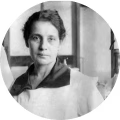 1878-1968
Lise Meitner
Austrian physicist, co-discoverer of nuclear fission. The Nobel Prize was awarded to
her collaborator Otto Hahn alone.
-
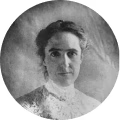 1868-1921
Henrietta Swan Leavitt
American astronomer, at the origin of the period-luminosity relationship of variable
stars, key to measuring distances in the universe. Her work served as the basis for
Hubble, without it being credited during her lifetime.
-
 1920-1958
Rosalind Franklin
British biophysicist whose X-ray diffraction images allowed the discovery of the
structure of DNA. Credits allocated mainly to Watson and Crick.
-
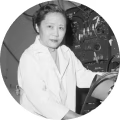 1912-1997
Chien-Shiung Wu
Chinese-American physicist, pioneer of nuclear physics. Her experiment on the
violation of parity earned a Nobel... to his male colleagues.
-
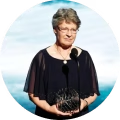 1897-1987
Josephine Bell
British astrophysicist having discovered the first pulsar. The Nobel Prize was
awarded to her thesis director, without mentioning her contribution.
To reveal the Mathilda effect is to
refuse forgetting. It is recognized that making women visible also means
transforming the way we conceive science: no longer as a reserved territory, but as a space of
shared and equitable
knowledge.