At the heart of the 1950s, she played an essential role in the experimental verification of a revolutionary idea: the violation of the law of parity. This experiment was not only a technical feat, but a bold challenge to a principle long considered universal.
The theory of parity: when nature looks in the mirror
Discover the article

Chien-Shiung Wu, a Chinese-American physicist of exceptional talent, is often nicknamed "the first lady of physics". Her journey, marked by a determination that led her to fundamental contributions
By Sacha Martin
On 10/20/2025 - 2 min of reading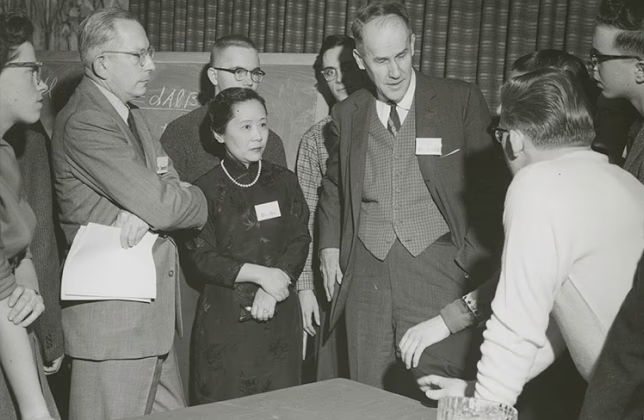 Chien Shiung Wu surrounded by students during a conference.
However, thanks to the meticulous experiment conducted by Chien-Shiung Wu, a surprising truth was brought to light. By studying the beta decay of cobalt-60 at very low temperatures, Wu irrefutably demonstrated that this symmetry was not universal.
She discovered that, for the weak interaction, left-right symmetry could be broken. The electrons emitted during decay showed a preferential direction, directly contradicting the principle of conservation of parity.
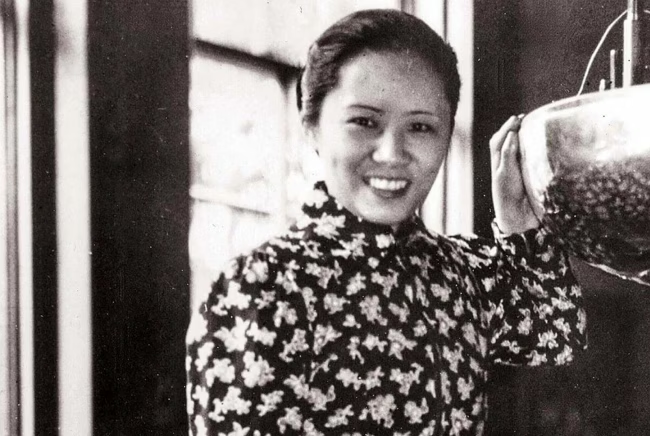 Chien-Shiung Wu assembles an electrostatic generator in the
laboratory.
Chien-Shiung Wu assembles an electrostatic generator in the
laboratory.
This discovery had a colossal impact, shaking the foundations of modern physics. It not only confirmed the bold hypothesis of theorists Tsung-Dao Lee and Chen-Ning Yang, but also forced physicists to reconsider their models of the universe.
Yet, despite the capital importance of his experimental work, it was Lee and Yang who were honored with the Nobel Prize in Physics in 1957 for their theoretical proposal – without Chien-Shiung Wu being mentioned, while his experience had provided the indispensable empirical proof.
Her work was long underestimated and her contribution, although recognized by her peers, did not receive the full recognition she deserved.
Nevertheless, the legacy of Chien-Shiung Wu remains today a powerful symbol of scientific rigor, perseverance and justice for women in science. His life and work continue to inspire future generations of scientists.
